

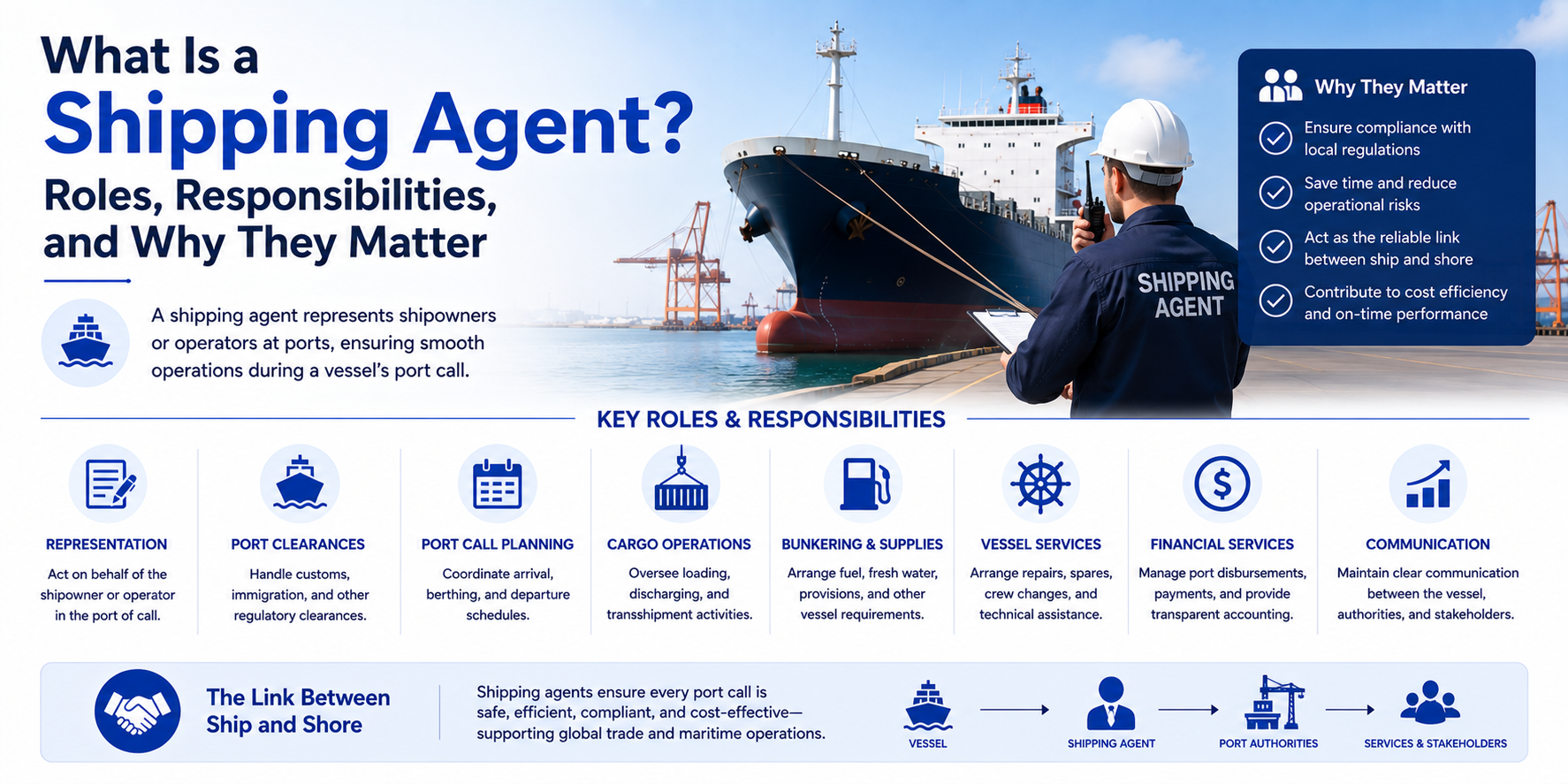
A shipping agent represents a shipping line or a ship owner in a local area. They arrange for the arrival of ships in port, documentation, customs clearance, discharge, and communication with port authorities to ensure ships complete their port calls as efficiently as possible, without unnecessary delays.
All ships entering port must comply with local requirements and regulations before they are allowed to proceed. Every aspect of what happens, from arranging the berth to documentation, customs, and cargo handling, has to be done correctly and promptly.
Positioned close to port authorities, terminal operators, customs officers, and service providers, shipping agents handle these responsibilities. They are local experts, which helps to minimize delays, foster communication, and contribute to the efficient operation of vessels throughout the port call.
Shipping agent: The representative of a shipping line or a vessel's operator in the port where the ship calls. They arrange the documentation, berths, customs, and other activities and communications with the port authorities to ensure that vessels function properly.
The shipping agent is the link at the port between the shipping line and the port. Their job is not only to get ready when a ship comes in, but also to make sure everything is prepared by the deadline and meets local and port laws and regulations before the ship leaves.
A shipping line is responsible for the operation of the ship and its commercial activities, while the shipping agent is responsible for the day-to-day operations at the port. This encompasses various other service providers such as the port authorities, terminal operators, customs officials, and others that help ensure efficient operations of the vessels.
The shipping agent generally:
If there is not adequate coordination run by the locals, vessels may experience delays, higher port charges, and schedule disruption.
|
Shipping Line |
Shipping Agent |
|
Has control and ownership of the vessel. |
Works for the shipping line in the local port. |
|
Plans routes and sailing plans |
Executes port-level operations |
|
Oversees world-class shipping services |
Organizes and coordinates local stakeholders and documents |
Simply put, the shipping line oversees the trip, while the shipping agent sees to the smooth running of all the arrangements at the port for that trip.
Shipping agents are significant because they are responsible for the local coordination required for each ship call at the port. They manage documentation and regulatory obligations, communicate with ports, and oversee cargo handling, ensuring timely processing, adherence to regulations, and the smooth functioning of global maritime trade.
Several parties are involved with a ship's visit, such as port authorities, terminal operators, customs, and service providers. Shipping agents are responsible for organizing these activities and making sure everything gets done promptly and that all parties get the information they need.
If there is no good coordination on the local level, vessels can suffer delays, port expenses, documentation problems, and operations problems.
These roles help shipping lines to efficiently move freight through all the ports and maintain good schedules by managing them.
A shipping agent is responsible for overseeing all aspects of a vessel's visit to a port, including arrangements for arrival and departure, as well as ensuring that the ship complies with the local authorities' regulations.
|
Stage |
The Job of the Shipping Agent |
|
Before Arrival |
Verifies the vessel schedule, makes berthing arrangements, fills in arrival paperwork, and organizes with the port and terminal operators. |
|
During Port Stay |
Carries out cargo operations, liaises with customs and prepares necessary marine operations, and gives operational information to the shipping line. |
|
Before Departure |
Fills out all paperwork for departure, gets port clearances, verifies regulations, and arranges for the ship to sail. |
Shipping agents facilitate each phase of the port call, minimizing delays, enhancing communication, and ensuring seamless vessel operations.
A shipping agent handles numerous operational and administrative duties to ensure that ships arrive at port and depart with smoothness and adherence to local rules.
|
Responsibility |
Why It Matters |
|
Vessel Coordination |
Arranges for ship arrival and departure, liaising with port and terminal staff. |
|
Port Documentation |
Fills out and turns in necessary paperwork for ports and regulations. |
|
Cargo Operations |
Co-ordinates with terminals and other partners in loading and unloading. |
|
Customs Coordination |
Collaborates with customs and regulatory bodies to facilitate quick ship clearance. |
|
Crew & Vessel Support |
Schedules crew and ship changes, local repairs and supplies as necessary. |
|
Operational Communication |
Ensures that shipping lines, customers and service providers are kept informed during the port call on the vessel. |
These responsibilities help prevent delays, enhance coordination, and facilitate smooth vessel operations throughout ports around the world.
Although these roles are closely connected, each has a different responsibility in the shipping process.
|
Aspect |
Shipping Agent |
Shipping Line |
Liner Agent |
Freight Forwarder |
|
Primary Role |
Manages local port operations |
Owns or operates vessels and shipping services |
Represents a shipping line operating scheduled services |
Arranges cargo transportation for shippers |
|
Represents |
Shipping line or vessel operator |
Own shipping business |
Liner shipping company |
Cargo owner or exporter/importer |
|
Main Focus |
Vessel coordination and port operations |
Vessel operations and global shipping network |
Coordinated services for liners in containers and local coordination |
The movement of cargo from end-to-end and logistics |
|
Coordinates With |
Port, terminal, customs, and service providers |
People involved in the shipping industry, customers, ports |
Shipping lines, terminals, and customers |
Carriers, Customs brokers, warehouses, and transport providers |
|
Handles Cargo Bookings |
No |
Yes |
Yes |
Yes |
|
Manages Port Documentation |
Yes |
No |
Yes |
Limited, depending on the shipment |
|
Supports Vessel Operations |
Yes |
Oversees operations |
Yes |
No |
|
Works At |
Local port |
Global shipping network |
Local port |
All the way along the logistics value chain |
A shipping line is responsible for the transport and operation of ships, whereas a shipping agent is responsible for the operations of the shipping port. Liners are supported by a liner agent, and cargo is arranged by a freight forwarder.
Operating efficiently with an experienced shipping agent assists vessels in considering local requirements and collaborating with key port call stakeholders.
|
Benefit |
Business Impact |
|
Faster Port Operations |
Coordinating efficiently can minimize vessel turnaround time |
|
Regulatory Compliance |
Compliance with local port/customs requirements is facilitated by accurate documentation |
|
Better Communication |
Maintains effective communication with shipping lines, terminals, authorities, and customers during the port call |
|
Reduced Operational Delays |
By coordinating proactively, problems can be discovered and solved in advance, before impacting the vessel schedules |
|
Local Port Expertise |
Local procedures are known, which helps to facilitate the activities at various ports |
|
Improved Supply Chain Efficiency |
On-time ships are part of a reliable cargo handling and delivery program |
The selection of the right shipping agent can impact the efficiency of operations, avoid needless delays, and aid in the reliable functioning of ships in both local and overseas ports.
1. What does a shipping agent do?
A shipping agent is a person who runs the local operation of the port for a shipping line or a shipping vessel. They are tasked with coordinating arrivals of vessels, documentation, cargo, customs, and communication with port authorities.
2. Who hires a shipping agent?
Shipping agents are nominated by a shipping line or a shipping vessel to represent the shipping line or shipping vessel at a particular port where they are operating and to take care of the operational needs of the shipping line or the shipping vessel at the port.
3. Do all vessels require a shipping agent?
Shipping agents are responsible for coordinating the operations in the port, making the necessary documentation, and making sure that local regulations are followed. Most of the commercial vessels rely on shipping agents for these.
4. What is the difference between a shipping agent and a freight forwarder?
A shipping agent assists the vessel in the port, and a freight forwarder is responsible for arranging the shipment from the shipper to the final destination.
5. May a shipping agent act as an agent for more than one shipping line?
Yes. Most shipping agents work for a number of shipping lines or vessel operators, as long as they have no contractual restrictions or conflicts of interest.
6. What kinds of documents does a shipping agent deal with?
Shipping agents are responsible for preparing and submitting shipping documentation and paperwork associated with shipping arrival, port clearance, cargo operations, customs requirements, and shipping departure.
7. What are the advantages of a shipping agent?
Shipping agents work closely with port officials, terminal companies, customs brokers, and service providers to ensure that shipping needs are fulfilled promptly without causing delays.
8. Is a shipping agent involved with shipping the cargo?
No. A shipping agent will handle the work at the port that relates to the ships, but transportation of cargo will be dealt with either by shipping lines, freight forwarders, or logistics providers.
The shipping agent is responsible for making a voyage to port a success. They facilitate shipping lines to manage operations across ports through the coordination, documentation, and communication management of local coordination.
During port operations, a shipping line agent maintains communication with everyone involved to minimize delays from the moment a ship arrives until it leaves the port.
For global shipping, a strong local support team is the key to transforming a schedule into a successful ship operation.

Your Global Trade Navigator, Delivering End-to-End Excellence and Unlocking New Opportunities in Every Link of Your Supply Chain.
Get In Touch

Explore our expert guide on Full Container Load (FCL) Shipping, covering benefits, processes, and tips to optimize your shipping experience efficiently.
Learn More FCL Shipping
SJ Logistics specializes in the global transportation of high-value, oversized cargo, ensuring safe and efficient delivery for your most complex project logistics needs.
Learn More Project Cargo

Discover tailored warehousing solutions at SJ Logistics, designed for efficiency and strategic storage. Optimize your supply chain with our innovative services today!
Learn More Warehousing
Discover comprehensive NVOCC solutions that streamline your logistics operations, enhance efficiency, and ensure seamless cargo management for your business needs.
Learn More NVOCC

Discover reliable inland transportation solutions that streamline your domestic logistics, ensuring timely and efficient delivery across the country.
Learn More Inland Transportation

Experience unparalleled convenience with our door delivery solutions, ensuring your packages arrive safely and promptly right at your doorstep. Discover more today!
Learn More Door Delivery

Experience seamless customs clearance with SJ Logistics. Our expert-led solutions ensure precision and efficiency, streamlining your import and export processes.
Learn More CHA

Experience unparalleled speed and reliability with our air freight services, ensuring your cargo reaches its destination swiftly and safely, no matter the distance.
Learn More Air Freight

Unlock the benefits of LCL shipping with our tailored solutions. Enjoy flexibility, cost savings, and strategic support designed for SMEs to thrive in global trade.
Learn More LCL Shipping