

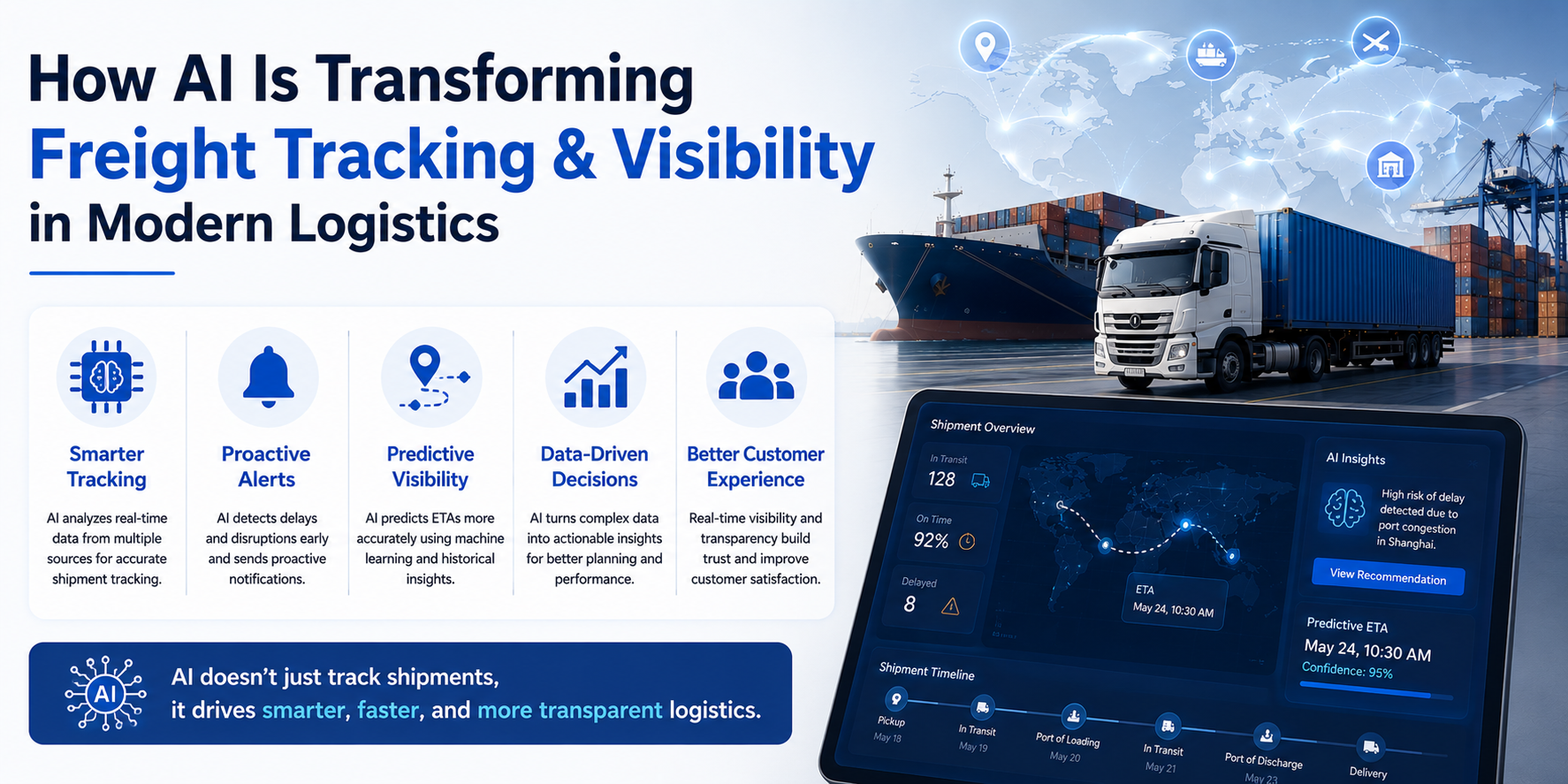
A container departs the port of Nhava Sheva with full tracking capabilities.
All looks fine in the beginning. But somewhere between the transshipment updates, the carrier systems, and the collaboration with customs, the visibility begins to dissipate. The shipment is still in transit, but there is no clarity.
For businesses, this absence of information quickly leads to uncertainty: calls are made, e-mails are sent, buyers request status updates, and the operations team is no longer guessing.
But this uncertainty rapidly propagates through the world of global logistics.
And it's precisely at this juncture where AI has begun to revolutionize freight tracking, not merely in moving cargo around more efficiently but in maintaining visibility throughout today's highly complex international supply chains.
Freight tracking has evolved from stage-based updates to real-time visibility.
Earlier, updates came only at key points like:
Now, businesses expect:
Modern freight forwarding is judged by the accuracy of visibility, not just the frequency of updates.
Because in logistics, poor visibility often creates more issues than delays in movement.
Traditional logistics often suffers from fragmented tracking across carriers, ports, transport systems, and customs networks.
This leads to:
Often, cargo moves normally; the visibility doesn’t.
This creates pressure on:
A delayed shipment is manageable, but poor visibility creates uncertainty across the entire operation.
That’s why businesses are investing in AI-powered visibility systems, shifting from reactive updates to early disruption awareness.
AI is turning freight tracking from passive updates into smart, real-time visibility.
It constantly analyzes data from:
So that systems are able to:
AI enabled systems can also:
For example, a ship's velocity slows down as it approaches a congested port, and then AI instantly adjusts the ETA rather than waiting for someone to catch up.
The real evolution here is that business no longer sees where goods are but what is about to occur.
AI is now moving beyond just tracking cargo to being able to predict delays before they occur.
Alerts can be generated when congestion is building at ports, and businesses are made aware of potential customs delays in advance or when shipment patterns change. ETAs adjust automatically.
This can address one of the main concerns of logistics – surprises.
Unexpected delays cost businesses more, compromise planning and upset customers.
It is not the movement of goods at greater velocity but the removal of uncertainty.
With shipment volumes on the rise in all of India's major export industries – Textiles, Chemicals, Engineering Goods, Pharmaceuticals, and Electronics – logistics providers are moving to more advanced solutions to replace old manual updates and improve the operational performance of their systems.
New AI visibility systems are helping to reduce follow-ups, increase transparency, speed up coordination with buyers, and process more shipments at a time efficiently. As these providers and exporters find more real-time visibility a critical feature, their global buyers' desire for accurate updates instead of delayed ones is growing. Visibility is truly becoming a core part of the customer experience in most industries today.
Integrating artificial intelligence into freight tracking systems produces instant operational benefits: Improved Planning, Less follow ups, Faster decision making, Increased customer confidence, and stronger supply chain control.
The primary benefit isn't faster tracking updates; it's improved operational predictability. The real improvement isn't faster updates; it's operational predictability.
Although technology has taken many leaps in freight tracking, there are still many limitations of AI-based tracking: most carriers don't provide real-time data in an organized way and some logistics providers still rely on manual data. The complexity of systems integration is also a major factor among many different stakeholders involved.
Challenges such as poor data quality, fragmented logistics systems, limited adoption by small-scale logistics companies, and difficulties integrating across global supply chains remain obstacles. AI visibility systems depend greatly on the operational data feeds which power them. The right technology is extremely capable of improving visibility; however, getting everyone on board with data flow remains a challenge.
By adopting new technologies, freight forwarders are not being made obsolete; they are becoming indispensable advisors. Businesses work with them now to:
Businesses investing in modern logistics visibility should focus on:
But perhaps the biggest shift is strategic.
Freight tracking is no longer just an operational tool.
It is becoming part of:
The companies that understand this early will build stronger logistics systems for the future.
Freight tracking is the process of monitoring cargo movement across different transportation stages using digital systems, carrier updates, and real-time logistics data.
AI improves freight tracking by combining multiple data sources, identifying delays early, predicting shipment movement, and improving visibility accuracy in real time.
Visibility helps businesses reduce uncertainty, improve planning, coordinate deliveries better, and maintain stronger communication across supply chains.
Predictive visibility uses AI to forecast shipment delays, congestion risks, route changes, and estimated delivery timelines before disruptions escalate.
Yes. Modern freight forwarders now manage integrated visibility systems, improve coordination, and provide strategic logistics insights beyond traditional shipment updates.
The industry is shifting from periodic updates to real-time visibility, from reaction to prediction, and from manual coordination to operational intelligence.
Businesses using fragmented tracking and delayed communication will struggle to match digitally connected supply chains built for speed and clarity.
This shift is already happening in global trade, and early adopters are gaining better control and confidence across their supply chains.
SJ Logistics India supports businesses with smarter coordination, technology-enabled tracking, and modern logistics processes.
In today’s logistics world, visibility is not just information; it is control.

Your Global Trade Navigator, Delivering End-to-End Excellence and Unlocking New Opportunities in Every Link of Your Supply Chain.
Get In Touch

Explore our expert guide on Full Container Load (FCL) Shipping, covering benefits, processes, and tips to optimize your shipping experience efficiently.
Learn More FCL Shipping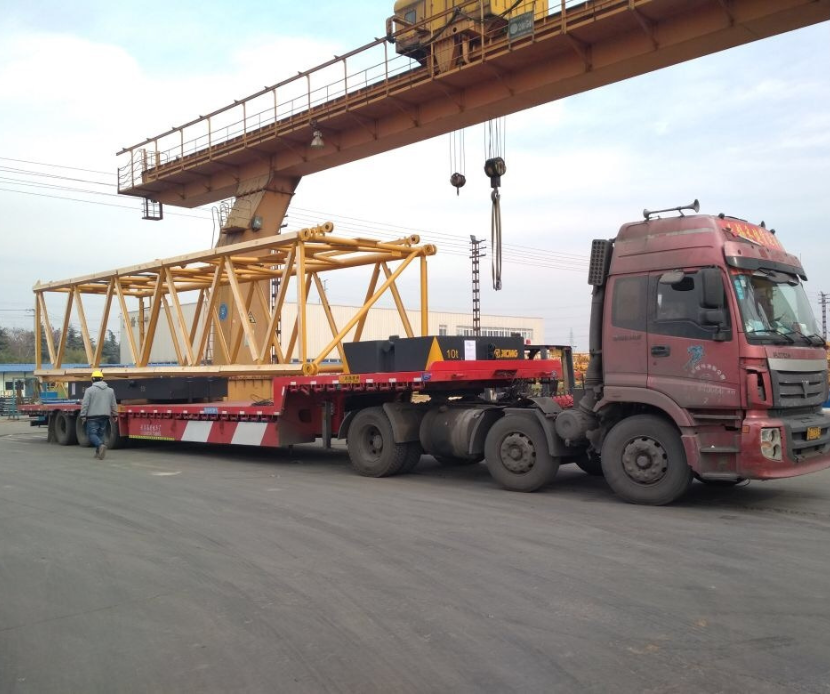
SJ Logistics specializes in the global transportation of high-value, oversized cargo, ensuring safe and efficient delivery for your most complex project logistics needs.
Learn More Project Cargo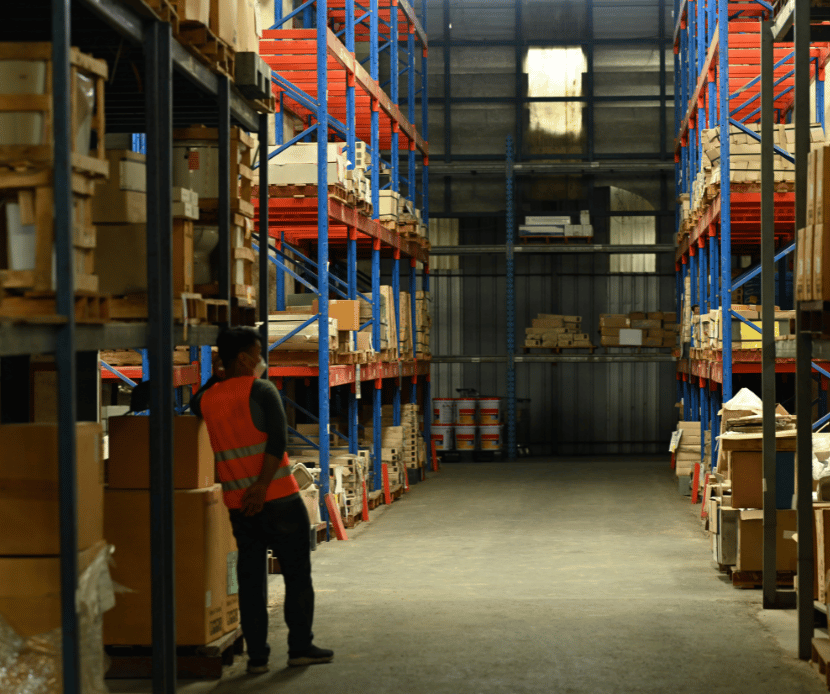

Discover tailored warehousing solutions at SJ Logistics, designed for efficiency and strategic storage. Optimize your supply chain with our innovative services today!
Learn More Warehousing
Discover comprehensive NVOCC solutions that streamline your logistics operations, enhance efficiency, and ensure seamless cargo management for your business needs.
Learn More NVOCC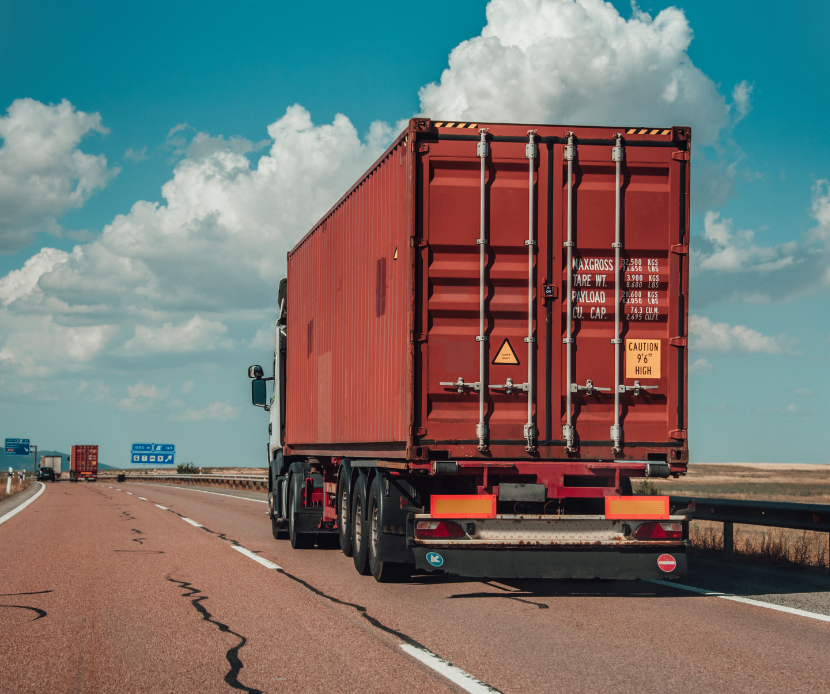

Discover reliable inland transportation solutions that streamline your domestic logistics, ensuring timely and efficient delivery across the country.
Learn More Inland Transportation

Experience unparalleled convenience with our door delivery solutions, ensuring your packages arrive safely and promptly right at your doorstep. Discover more today!
Learn More Door Delivery

Experience seamless customs clearance with SJ Logistics. Our expert-led solutions ensure precision and efficiency, streamlining your import and export processes.
Learn More CHA

Experience unparalleled speed and reliability with our air freight services, ensuring your cargo reaches its destination swiftly and safely, no matter the distance.
Learn More Air Freight

Unlock the benefits of LCL shipping with our tailored solutions. Enjoy flexibility, cost savings, and strategic support designed for SMEs to thrive in global trade.
Learn More LCL Shipping