

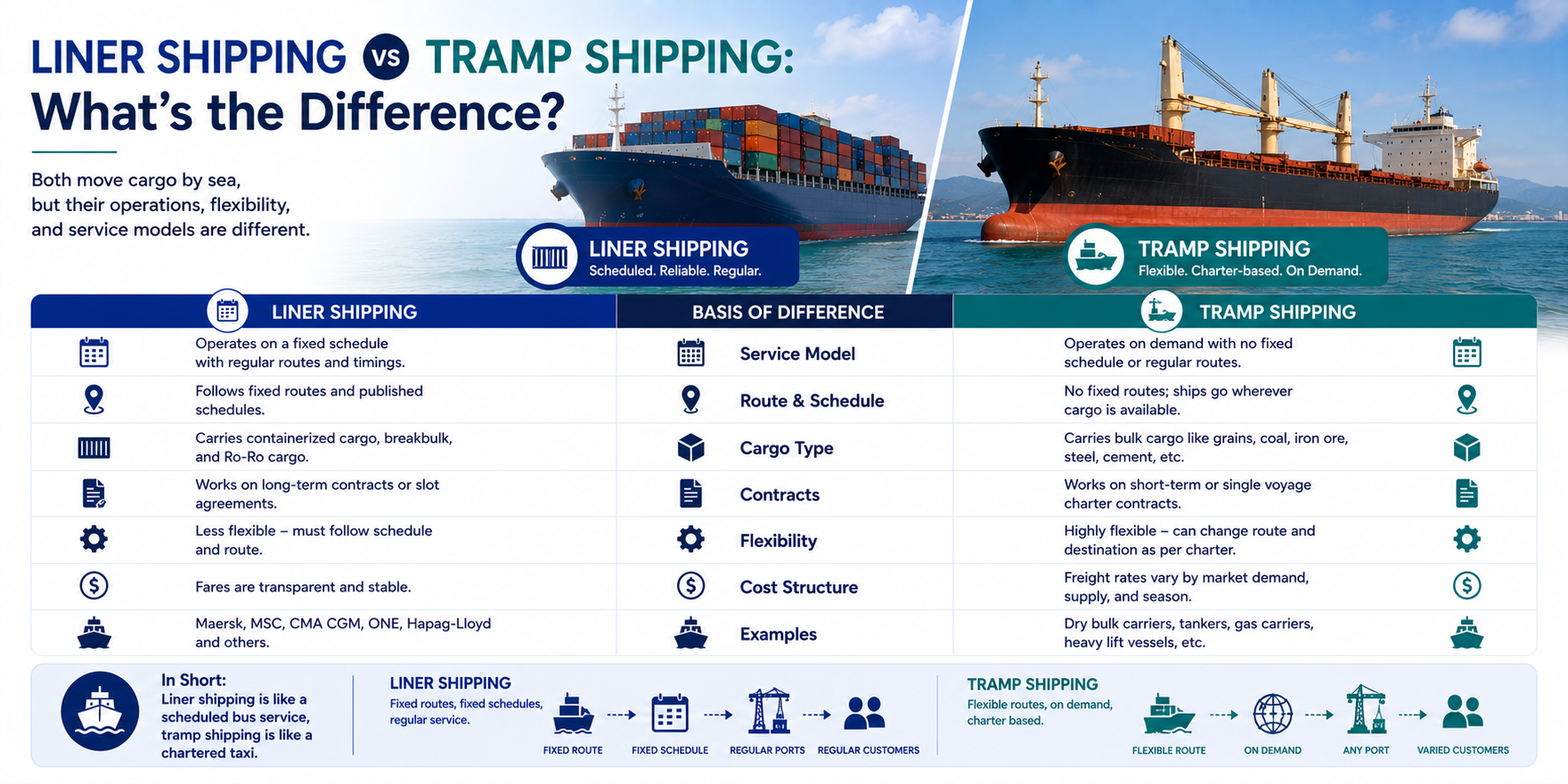
There are two types of commercial shipping: liner shipping and tramp shipping.
Liner shipping is a service that runs between pre-planned ports of call on regular schedules. Tramp shipping is run on an ad hoc basis; ships are used to carry cargo as required by charter arrangements.
The main distinction is the use to which the vessel is put in commerce. Liner shipping involves the purchase of cargo space on a regular service, whereas tramp shipping usually requires chartering a vessel for a particular voyage, cargo, or period.
Most of the time, containerized goods are transported by liner services. Tramp shipping is especially efficient for dry bulk, liquid bulk, project cargo, and other goods that might need the flexibility of a tramp vessel.
Liner shipping is a regular, pre-arranged sea transportation system between a fixed set of ports. Shipping lines release sailing schedules and port rotations, enabling several shippers to have cargo space on the same sailing.
The properties of a liner service include:
A shipping company could run regular connections between Nhava Sheva, Jebel Ali, Jeddah and Alexandria, for instance. If the sailing schedule is available, the exporter can reserve space in a container instead of chartering a vessel.
The emphasis of liner shipping is on a reliable and repeatable cargo service.
A model of vessel employment, that is to say, tramp shipping, is a sailing boat that does not follow a fixed trade route or fixed sailing schedule. Rather, the ship is being used in accordance with the cargo, market demand, and agreement between the shipowner and charterer.
The usual elements of tramp shipping include:
For instance, a grain trader might want to transport a big batch of grain from one port to another. The company would charter a bulk carrier instead of taking a few containers on a scheduled liner service for the voyage.
Once that trip is done, the ship can be used again for other cargo and destinations.
The emphasis in tramp shipping is on matching the capacity of vessels with particular shipments.
The biggest difference is in how vessels are scheduled, routed, and hired.
|
Aspect |
Liner Shipping |
Tramp Shipping |
|
Routes |
Established or anticipated trading routes |
Organised for cargo needs |
|
Schedules |
Published and regular |
Flexible and cargo-dependent |
|
Port Calls |
Regular port rotation |
Chosen for each trip |
|
Cargo |
Mainly containerized cargo |
Primary cargo types: bulk, project, and various charter cargo |
|
Customers |
Multiple shippers |
A charterer who is organizing the use of a ship |
|
Booking |
The space for goods is reserved |
A vessel is hired or a vessel’s capacity is hired |
|
Pricing |
Service rates and the market rate are used to determine this |
Negotiated according to terms in the charter and market conditions |
|
Vessel Use |
This part of a regular service network |
For special voyages or times of year |
|
Flexibility |
Lower route flexibility |
More flexible routes and schedules |
|
Main Focus |
Regular cargo service |
Flexible vessel employment |
Simply put, liner shipping is a regular service, and tramp shipping is a flexible VES (vessel employment service) model.
The hiring of ships is an important aspect of tramp shipping. The exact arrangement varies, depending on the vessel's use for one trip, a time, or a longer cargo commitment.
|
Charter Type |
How It Works |
|
Voyage Charter |
The ship is chartered for a particular voyage from predetermined ports |
|
Time Charter |
The ship is leased for a specific time |
|
Contract of Affreightment |
The carrier will guarantee that goods will be transported within a specific limit for a specified period |
This provides increased flexibility to the cargo owner in cases of need when their cargo needs do not coincide with the regular liner schedule.
The right one will depend on you, your cargo, how much you need to transport, your route, when you need to transport it, and your vessel's needs.
|
If You Need... |
Better Fit |
Why |
|
Regular container shipments |
Liner Shipping |
Schedules are available for booking cargo |
|
Predictable sailing dates |
Liner Shipping |
Ships run on the schedule |
|
Regular port-to-port service |
Liner Shipping |
Ships conduct a rotation of ports |
|
A vessel for large cargo |
Tramp Shipping |
The capacity of the vessel can be arranged for the cargo |
|
Ports for flexible loading/unloading |
Tramp Shipping |
Ports may be chosen according to the voyage requirements |
|
Bulk cargo movement |
Tramp Shipping |
In this market, bulk carriers are typically used |
|
A ship that has been used for a certain length of time |
Tramp Shipping |
The time charter arrangement gives access to the vessel |
|
Single or occasional freight transport |
Tramp Shipping |
The vessel can be employed around the specific requirement |
A typical example is the business firm that exports containers on a regular basis from India to Europe, which will typically involve a liner service. For firms that need to transport a significant volume of bulk goods from one port to another, tramp shipping might be a better option.
Yes, a vessel's commercial employment can change.
Liner and tramp lines are not just a matter of the ships themselves. It is primarily a matter of the way the boat is used and driven.
A ship running in a liner service network runs on a predetermined service and port rotation. A ship that is used in the tramp market might also charter out on single voyages or charter periods depending on the cargo on board.
It is for this reason that the same general vessel classification can be employed in various commercial modes based on market conditions and cargo needs.
Liner shipping is the regular transportation of goods between scheduled ports, and tramp shipping is the transportation of goods by a vessel according to the needs of the cargo and with a charter.
2. Does liner shipping apply just to containers?
The most frequently used cargo on liner services is containerized, but vehicles, breakbulk, and other types of cargo can also be transported by liner.
3. Does tramp shipping only apply to bulk?
No. Tramp shipping is tightly coupled with dry bulk or liquid bulk shipping, but may also be used for project shipping, or the shipping of cargo which calls for flexible vessel configuration.
4. In liner shipping, who determines the schedule?
The service timetable is set and determined by the shipping line, when and where the ports will rotate, and when and where the ships will sail.
5. In the case of tramp shipping, who determines the route?
The route is normally fixed based on the cargo requirement and conditions that have been agreed with the shipowner and charterer.
6. What is more flexible, liner or tramp shipping?
Generally, tramp shipping is more flexible because vessels can be used for given services, cargoes, or time periods instead of a fixed shipping network.
7. Is there any possibility of using the same vessel for liner and tramp services?
Potentially, yes. It is not just the vessel but the employment of the vessel that makes the difference.
Liner shipping is most suited to regular services, scheduled service, and cargo space on routes.
Tramp shipping is more appropriate for large and irregular or specialised cargo which requires flexibility in the use of vessels.
It is dependent on the type of cargo, size of cargo, destination, cargo time, and charter needs. Knowing these distinctions can assist companies in picking the right shipping model that matches their business needs and shipment approach.

Your Global Trade Navigator, Delivering End-to-End Excellence and Unlocking New Opportunities in Every Link of Your Supply Chain.
Get In Touch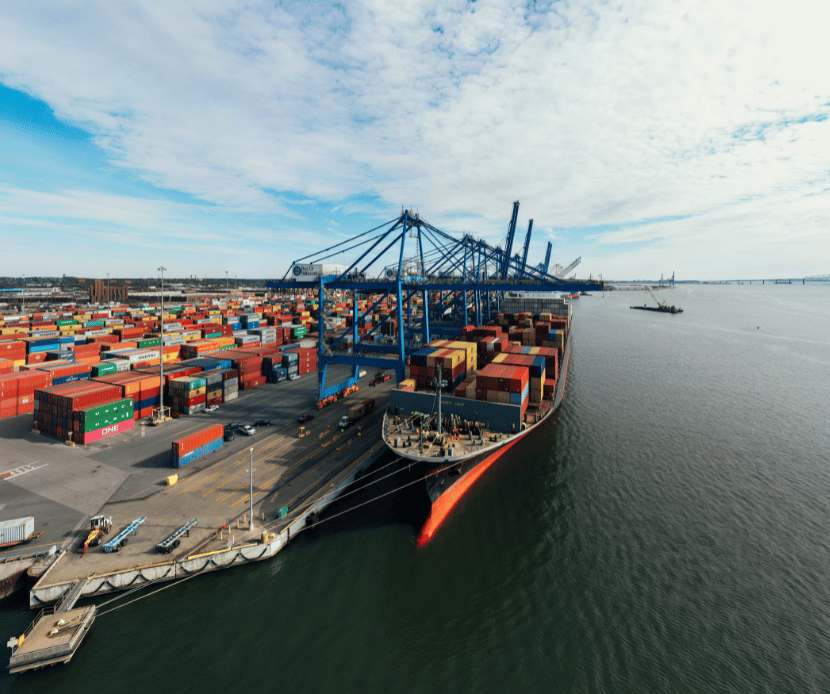

Explore our expert guide on Full Container Load (FCL) Shipping, covering benefits, processes, and tips to optimize your shipping experience efficiently.
Learn More FCL Shipping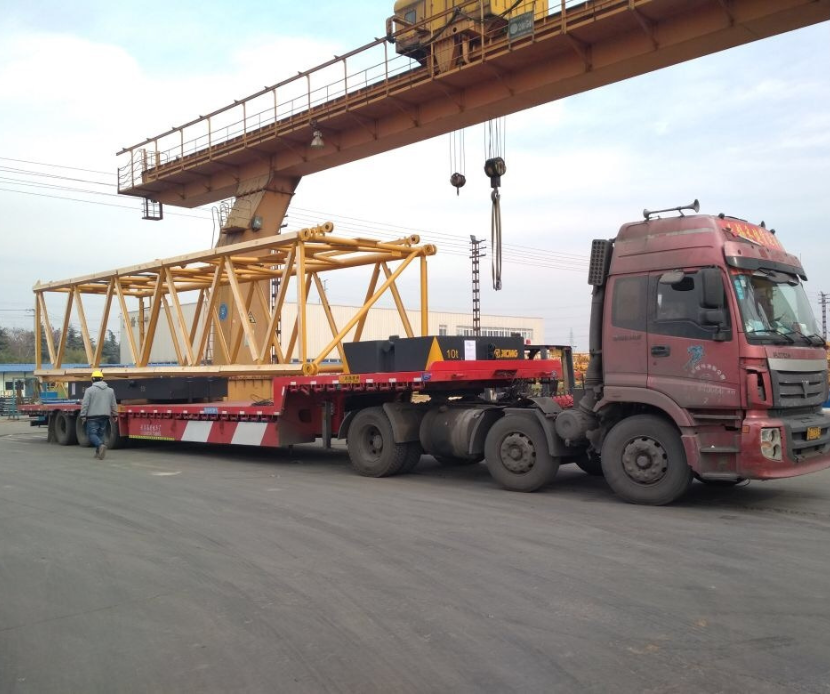
SJ Logistics specializes in the global transportation of high-value, oversized cargo, ensuring safe and efficient delivery for your most complex project logistics needs.
Learn More Project Cargo

Discover tailored warehousing solutions at SJ Logistics, designed for efficiency and strategic storage. Optimize your supply chain with our innovative services today!
Learn More Warehousing
Discover comprehensive NVOCC solutions that streamline your logistics operations, enhance efficiency, and ensure seamless cargo management for your business needs.
Learn More NVOCC

Discover reliable inland transportation solutions that streamline your domestic logistics, ensuring timely and efficient delivery across the country.
Learn More Inland Transportation

Experience unparalleled convenience with our door delivery solutions, ensuring your packages arrive safely and promptly right at your doorstep. Discover more today!
Learn More Door Delivery

Experience seamless customs clearance with SJ Logistics. Our expert-led solutions ensure precision and efficiency, streamlining your import and export processes.
Learn More CHA

Experience unparalleled speed and reliability with our air freight services, ensuring your cargo reaches its destination swiftly and safely, no matter the distance.
Learn More Air Freight

Unlock the benefits of LCL shipping with our tailored solutions. Enjoy flexibility, cost savings, and strategic support designed for SMEs to thrive in global trade.
Learn More LCL Shipping