

Flat rack and open top containers allow exporters to move heavy or oversized cargo that standard containers cannot handle.
Not all cargo fits inside a standard container. Heavy machinery, large equipment, and oversized structures often require specialized containers for safe transport.
This is where flat rack and open top containers are used in international shipping.
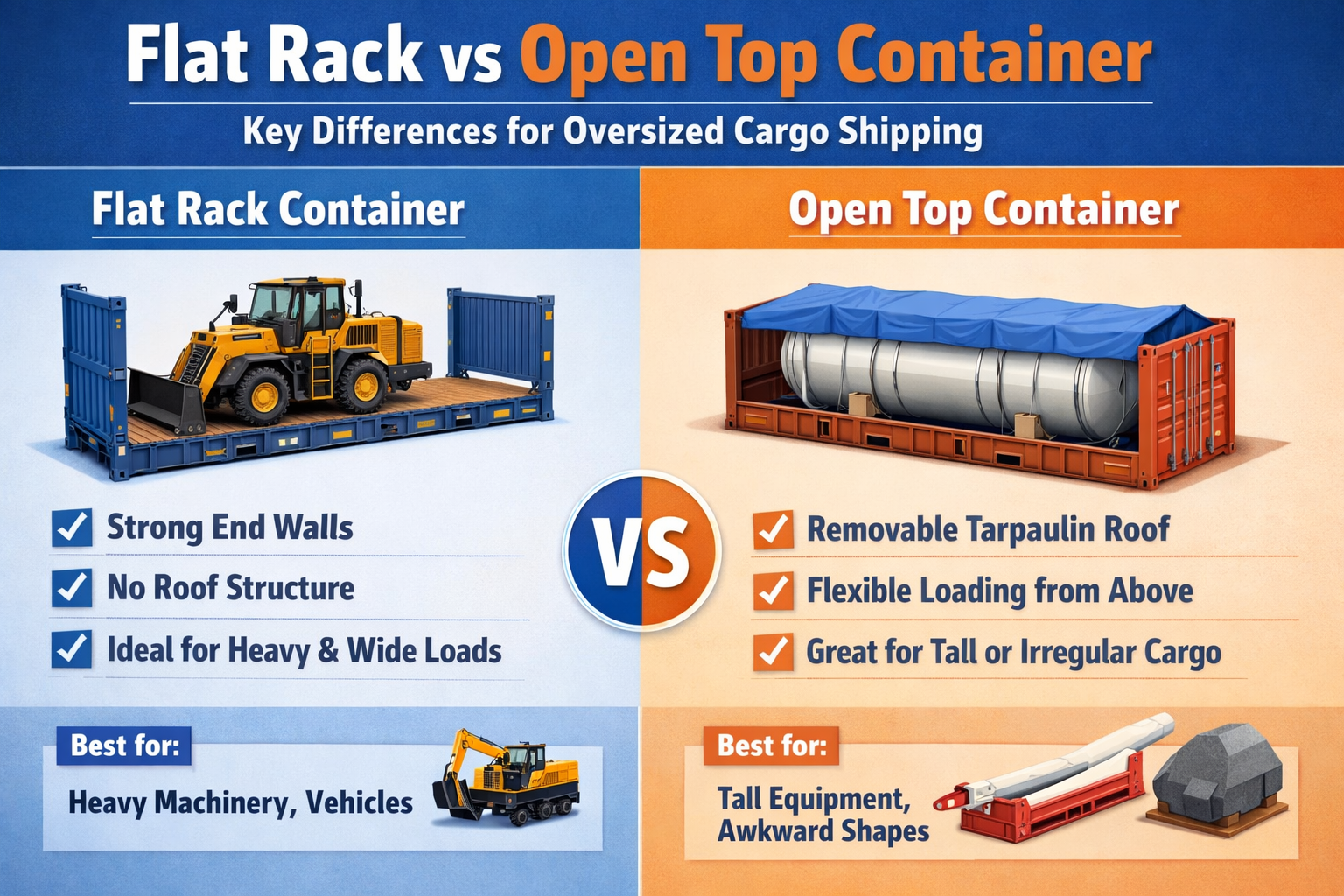
A flat rack container is a specialized shipping container designed for heavy or oversized cargo that cannot fit inside standard containers. It has a strong base with collapsible or fixed end walls, but no side walls or roof.
This open structure allows cargo to be loaded from the top or the sides, making it suitable for large and heavy equipment.
Flat rack containers are widely used for project cargo and oversized shipments, especially when cargo dimensions exceed standard container limits.
An open top container is a shipping container designed for cargo that is too tall to be loaded through standard container doors. Instead of a solid roof, it has a removable tarpaulin cover, allowing cargo to be loaded from the top using cranes.
Unlike flat rack containers, open top containers still have side walls, which help secure and protect the cargo during transport.
Open top containers are useful when cargo fits within the container width and length but exceeds the height limits of a standard container.
Both flat rack and open top containers are typically available in 20-foot and 40-foot sizes, following international container standards used in global shipping.
|
Container Type |
Length |
Width |
Height |
|
20ft Flat Rack |
~20 ft |
~8 ft |
Open |
|
40ft Flat Rack |
~40 ft |
~8 ft |
Open |
|
20ft Open Top |
~20 ft |
~8 ft |
~8 ft 6 in |
|
40ft Open Top |
~40 ft |
~8 ft |
~8 ft 6 in |
Flat rack containers allow cargo to extend beyond the sides or height, while open top containers maintain standard container dimensions but allow vertical loading from the top.
Both containers are used for oversized or heavy cargo, but they serve different shipping needs. The structure of each container determines how cargo is loaded and transported.
|
Feature |
Flat Rack Container |
Open Top Container |
|
Structure |
No side walls or roof, only a strong base with end walls |
Has side walls and doors but no solid roof |
|
Cargo Loading |
Loaded from the top or sides using cranes |
Loaded from the top using cranes |
|
Best For |
Extremely wide or oversized cargo |
Cargo that is too tall for standard containers |
|
Protection |
Cargo secured with lashing and covers |
Covered with a tarpaulin sheet |
|
Common Cargo |
Heavy machinery, vehicles, industrial equipment |
Machinery, timber, large equipment |
Flat rack containers are used when cargo extends beyond container width, while open top containers work when cargo fits the width but exceeds height limits.
The loading method is one of the biggest differences between these two container types.
Flat rack containers allow side loading or top loading, which makes them suitable for extremely large or heavy cargo. Cranes or forklifts can place cargo directly onto the container platform, and the cargo is secured using lashing equipment.
Because there are no side walls, flat rack containers can accommodate cargo that extends beyond container dimensions.
Open top containers are designed for vertical loading using cranes. Cargo is placed into the container through the open roof and positioned inside the container walls.
Once the cargo is secured, the container is covered with a tarpaulin sheet to protect it from weather conditions during transport.
Flat rack and open top containers are mainly used for cargo that cannot fit inside standard containers due to size, weight, or loading limitations.
Flat rack containers are ideal for extremely heavy or wide cargo that needs loading from the side or top.
Examples include:
Open top containers are used when cargo fits within container width and length but exceeds height limits.
Examples include:
The choice between flat rack and open top containers usually depends on cargo dimensions, weight, and loading method.
The choice between flat rack and open top containers depends mainly on the size of cargo and how it will be loaded.
|
Shipping Situation |
Best Container Type |
Reason |
|
Cargo is extremely wide or oversized |
Flat Rack Container |
No side walls, allowing cargo to extend beyond container width |
|
Cargo requires side loading |
Flat Rack Container |
Open sides make crane or forklift loading easier |
|
Cargo is too tall for standard containers |
Open Top Container |
Open roof allows vertical loading |
|
Cargo fits width and length but exceeds height limit |
Open Top Container |
Tarpaulin cover protects cargo after top loading |
|
Cargo is very heavy industrial equipment |
Flat Rack Container |
Strong base supports heavy loads |
Using the correct container type helps ensure safe loading, proper cargo securing, and efficient international transport.
The choice between flat rack and open top containers depends mainly on cargo dimensions and loading requirements.
Selecting the right container helps ensure safe cargo handling, efficient loading, and smooth international shipping operations.
1. What is a flat rack container used for?
A flat rack container is used to transport heavy or oversized cargo such as machinery, vehicles, and industrial equipment.
2. What is an open top container used for?
An open top container is used for cargo that is too tall to be loaded through standard container doors and needs crane loading from the top.
3. What is the main difference between flat rack and open top containers?
Flat rack containers have no side walls, while open top containers have side walls but no fixed roof.
4. Can oversized cargo be shipped in open top containers?
Yes, but only if the cargo fits within the container width and length. For wider cargo, flat rack containers are usually used.
5. Which container is better for heavy machinery?
Flat rack containers are commonly preferred for heavy machinery and large industrial equipment.
Moving heavy or oversized cargo requires the right container type and proper planning. Using the correct equipment helps ensure safe loading, secure transport, and smooth international shipping operations.
At SJ Logistics, we support businesses with container solutions for oversized and project cargo, including flat rack and open top container shipping.
Connect with our logistics team to plan reliable cargo transport for your international shipments.

Your Global Trade Navigator, Delivering End-to-End Excellence and Unlocking New Opportunities in Every Link of Your Supply Chain.
Get In Touch

Explore our expert guide on Full Container Load (FCL) Shipping, covering benefits, processes, and tips to optimize your shipping experience efficiently.
Learn More FCL Shipping
SJ Logistics specializes in the global transportation of high-value, oversized cargo, ensuring safe and efficient delivery for your most complex project logistics needs.
Learn More Project Cargo

Discover tailored warehousing solutions at SJ Logistics, designed for efficiency and strategic storage. Optimize your supply chain with our innovative services today!
Learn More Warehousing
Discover comprehensive NVOCC solutions that streamline your logistics operations, enhance efficiency, and ensure seamless cargo management for your business needs.
Learn More NVOCC

Discover reliable inland transportation solutions that streamline your domestic logistics, ensuring timely and efficient delivery across the country.
Learn More Inland Transportation

Experience unparalleled convenience with our door delivery solutions, ensuring your packages arrive safely and promptly right at your doorstep. Discover more today!
Learn More Door Delivery

Experience seamless customs clearance with SJ Logistics. Our expert-led solutions ensure precision and efficiency, streamlining your import and export processes.
Learn More CHA

Experience unparalleled speed and reliability with our air freight services, ensuring your cargo reaches its destination swiftly and safely, no matter the distance.
Learn More Air Freight

Unlock the benefits of LCL shipping with our tailored solutions. Enjoy flexibility, cost savings, and strategic support designed for SMEs to thrive in global trade.
Learn More LCL Shipping